
"Now He Belongs to the Ages"
Memory, Fragmentation, and the Afterlife of Abraham Lincoln
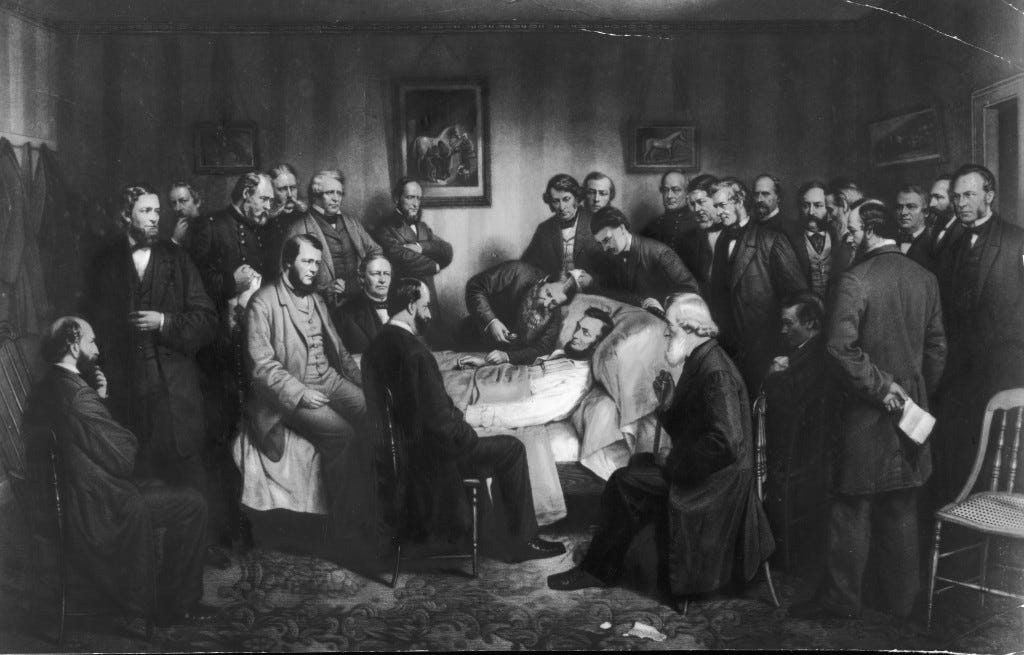
On the morning of April 15, 1865, Abraham Lincoln died in the Petersen House across from Ford’s Theatre, struck down just as the Civil War seemed to be closing. Around him stood members of his cabinet, physicians, soldiers, and friends, all gathered in the stunned quiet that follows political murder. Out of that silence came the sentence that has clung to the event ever since. Edwin Stanton, Lincoln’s Secretary of War, is said to have declared, “Now he belongs to the ages.” Historians have long noted that there is a competing version, “angels,” but “ages” is the phrasing that entered public memory because it names something larger than grief. It suggests that Lincoln’s death did not end his public life. It changed its form.1
That is the deeper force of Stanton’s words. They were not only an elegy. They were a recognition that Lincoln, in death, would pass from politics into memory, and that memory would become one of the central battlegrounds of American life. A statesman can act within time. A martyr is interpreted by it. Once Lincoln “belonged to the ages,” he no longer belonged just to April 1865, or even to the Civil War. He belonged to every later generation that would look back to him for sanction, warning, comfort, legitimacy, or rebuke.
That is why Lincoln’s death matters now. It is not merely because it was tragic, or because it robbed the nation of a president at the very moment of victory. It matters because his death clarified the fragility of the political order he had spent his career trying to preserve and redefine. The Union survived militarily, but survival was not the same thing as settlement. The war had answered whether the United States could be broken by secession. It had not yet answered what kind of nation would emerge from the struggle, or whether the principles Americans invoked so easily could survive the bitterness, exhaustion, and violence that the war produced. That uncertainty is what makes Lincoln’s death feel unsettlingly modern. It took place at a moment when formal victory coexisted with moral and political instability. The country had not ceased being divided simply because one side had lost.2
Lincoln had understood that danger long before he entered the White House. In 1838, as a young man in Springfield, he warned that the republic would not be destroyed by some grand foreign conqueror. “At what point then is the approach of danger to be expected?” he asked. “I answer: If it ever reach us it must spring up amongst us; it cannot come from abroad. If destruction be our lot we must ourselves be its author and finisher.”3 It remains one of the most arresting sentences in American political writing because it identifies a truth that democracies prefer to avoid. The chief danger is often internal. A free people can undo its own institutions. A republic can decay through habits of contempt, self deception, and lawlessness as easily as through invasion.
Lincoln’s Lyceum Address is often remembered for its warnings about mob violence, and rightly so, but its larger discussion was memory. He belonged to a generation born after the Revolution, a generation that had inherited the institutions of the founders without having experienced the sacrifices that created them. What would hold such a people together when living memory of the founding had faded? Lincoln’s answer was not sentiment. He called instead for what he described as a “political religion” of reverence for the laws. The phrase can sound severe, but Lincoln’s point was clear. A republic could not survive on emotion alone. It required discipline, restraint, and a cultivated loyalty to institutions larger than appetite or faction.
Yet Lincoln did not treat the founding as sacred in a static sense. He did not merely preserve inherited language, he reinterpreted it as a historian and citizen. In the crisis over slavery, he turned repeatedly to the Declaration of Independence, not because he believed the founders had achieved equality, but because they had announced a principle that future generations were obligated to make more real. The Declaration, for Lincoln, was not a museum piece. It was a claim on the conscience of the present.
That conviction appears with unusual force in his 1855 letter to Joshua Speed. Writing amid the turmoil unleashed by the Kansas Nebraska Act, Lincoln confessed both disgust and alarm. “Our political problem now,” he wrote, “‘Can we, as a nation, continue together permanently, forever, half slave and half free?’” He then reached for an image that reveals how deeply he thought in terms of inheritance and repair: “Our republican robe is soiled, and trailed in the dust. Let us repurify it.”4 Lincoln was not pretending that the robe had ever been spotless. He was insisting that the nation’s principles had been degraded and that their recovery would require conscious moral effort.
This is one reason Lincoln still speaks so clearly to a fractured age. He understood that political language becomes hollow when detached from ethical seriousness. He also understood that the answer is not to discard principle but to test it, recover it, and force it to bear weight again.
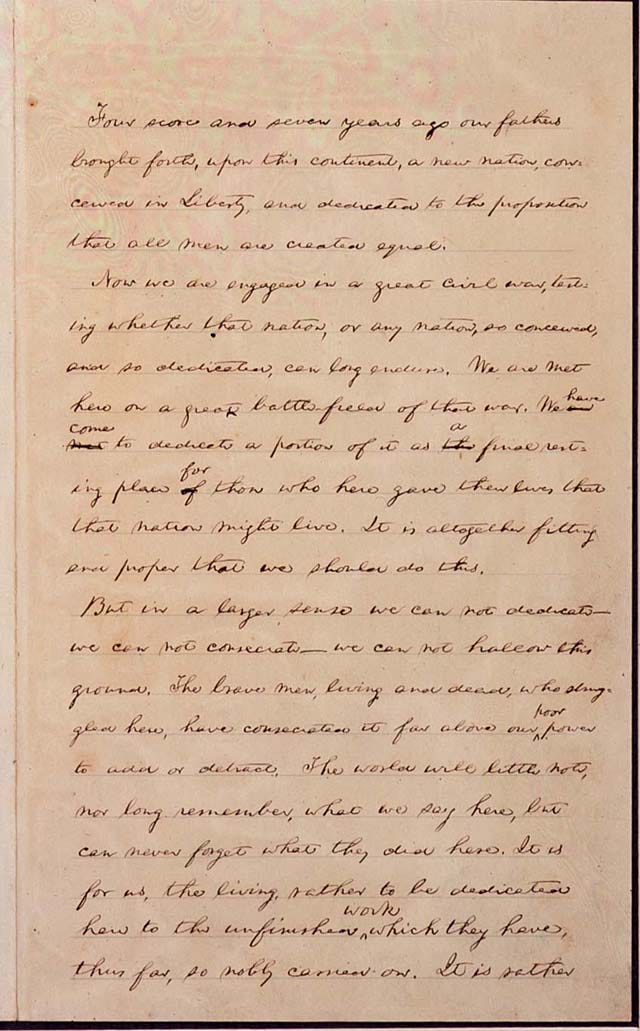
The Gettysburg Address is the clearest example. Lincoln did not describe the United States as a mere constitutional arrangement or a loose federation of interests. He called it “a nation, conceived in Liberty, and dedicated to the proposition that all men are created equal.” He then defined the Civil War as a test of “whether that nation, or any nation so conceived and so dedicated, can long endure.”5 Those lines are quoted so often that they can lose their sharpness, but their argument is daring. Lincoln was not simply saying that the Union should survive. He was saying that the fate of republican government itself was bound up with the fate of the American experiment. If a democracy built on liberty and equality could not survive its own contradictions, what confidence could any republic claim?
Even more striking is the movement of the speech from remembrance to obligation. Lincoln begins by honoring the dead, but quickly tells his listeners that ceremonial reverence is not enough. “It is for us the living,” he says, “to be dedicated here to the unfinished work.”6 That phrase, “unfinished work,” is essential. The dead are not honored merely by memory. They are honored by continuation. Lincoln’s rhetoric turns mourning into duty.
By March 1865, that same moral seriousness had deepened into something darker and more searching. In the Second Inaugural, Lincoln refused to flatter the North with innocence. He named slavery directly as the cause of the war and suggested that the conflict itself might be read as judgment. “Both parties deprecated war,” he observed, “but one of them would make war rather than let the nation survive, and the other would accept war rather than let it perish. And the war came.”7 Few public sentences are so stripped of ornament and so devastating in effect. The war did not descend from nowhere. It came from choices, from interests, from moral evasions long tolerated.
Lincoln then moved into a theological register that still startles modern readers. “Fondly do we hope, fervently do we pray, that this mighty scourge of war may speedily pass away.” But he would not cheapen peace by separating it from justice. If the war had to continue until “every drop of blood drawn with the lash shall be paid by another drawn with the sword,” then so be it.8 This is not sentimental reconciliation, it is sober reckoning. Lincoln recognized that a nation built in part through slavery could not emerge from civil war morally intact by simple declaration.
And yet the address ends not in vengeance but in disciplined mercy: “With malice toward none, with charity for all, with firmness in the right as God gives us to see the right, let us strive on.”9 That sentence is often domesticated into a generic plea for kindness. Lincoln was not asking the country to forget what had happened. He was asking it to reconstruct itself without surrendering either justice or human empathy.
His assassination made that task infinitely harder. The question after April 15 was no longer simply what Lincoln had believed, but what Americans would make of him now that he could no longer speak for himself. The public reaction was immediate, vast, and raw. A letter written from Washington on the day of his death described “the Nation’s terrible calamity” and insisted that “the heart of the nation throbs with grief at a loss it cannot soon repair.” The writer had just passed the house “where little less than an hour ago the nation’s heart and life ceased to beat for its welfare.” At a theater, after the audience learned what had happened, “strong men wept like little children.”10 For many Americans, Lincoln’s death felt less like the passing of an officeholder than the collapse of a structure that had held together public meaning during years of war.
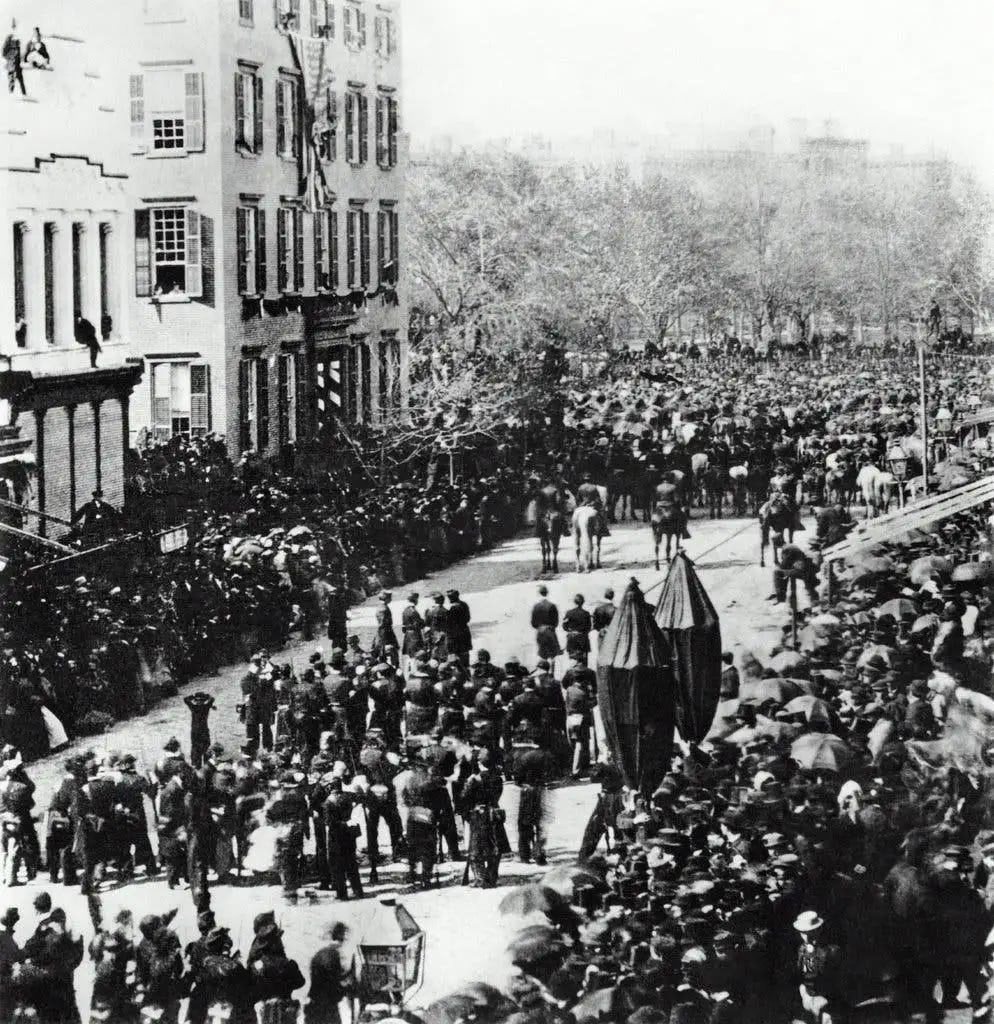
The funeral processions that followed turned grief into national ritual. In Washington, immense crowds lined Pennsylvania Avenue as Lincoln’s body was taken to the Capitol. According to the Library of Congress, spectators filled “windows, porticos, rooftops, and all elevated places,” while the procession itself included soldiers, politicians, Lincoln’s sons, and a detachment of Black troops.11 The scale of mourning mattered because it gave form to the idea that Lincoln belonged not only to a party or region, but to the nation. Yet even that claim was unstable. To whom did Lincoln belong, really? To white Unionists who saw him as the savior of the Union? To freed people who associated him with emancipation? To moderates who wanted national reconciliation? To radicals who wanted a stronger remaking of the South?
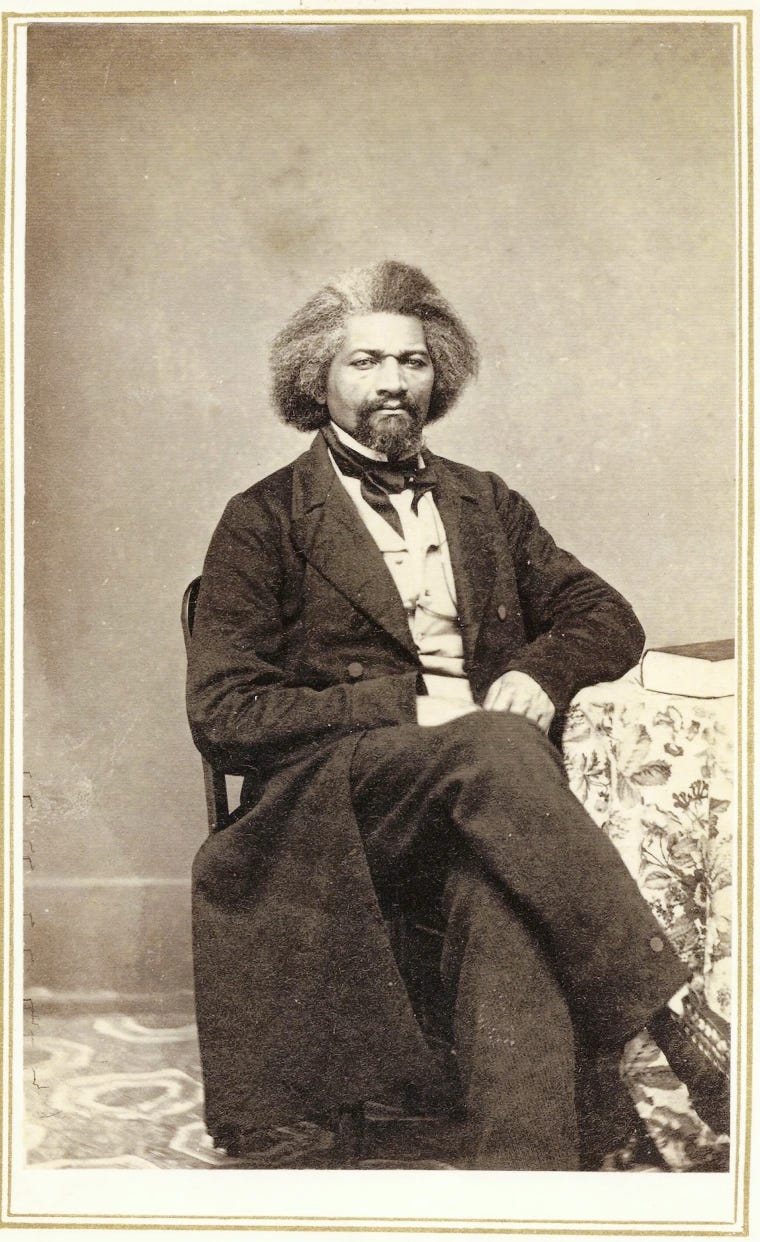
Frederick Douglass gave one of the most penetrating answers. He refused both hagiography and ingratitude. In one of his sharpest formulations, Douglass wrote that Lincoln:
While unsurpassed in his devotion to the welfare of the white race, was also in a sense hitherto without example, emphatically, the black mans President: the first to show any respect to their rights as men.”12
No sentence better captures the difficulty of remembering Lincoln honestly. Douglass did not erase Lincoln’s limitations, nor did he ignore his greatness. Lincoln was not an abolitionist prophet in the mold of Douglass himself. But he was the president under whom emancipation became federal policy and Black claims to manhood entered the center of national politics. Douglass’s memory of Lincoln is valuable precisely because it resists simplification.
That resistance matters now because our own age is so hungry for simplified pasts. We tend to demand either purity or hypocrisy, saints or frauds, usable heroes or disposable villains. Lincoln does not fit comfortably into those categories. He was shaped by the racial assumptions of his time, yet he also helped force the nation beyond them. He revered the founders, yet he did not read them as an alibi for inaction. He defended law, yet he understood that law without justice can become a shield for disorder of a more respectable kind. He sought union, but he did not finally separate union from the moral question of slavery.
This is why Lincoln’s death still illuminates a turbulent present. We too inhabit a political culture marked by mutual suspicion, institutional distrust, public anger, and rival historical narratives. We too argue over what the nation means, what the founding promised, and whether inherited principles still possess binding authority. We too are tempted either to idolize the past or discard it. Lincoln offers no easy therapy for such conditions. He offers something harder and more useful. He shows how memory can become a form of civic labor.
To remember Lincoln well is not to repeat his most famous lines as if quotation were fidelity. It is to see how he used the past. He did not invoke the founders to end argument, he invoked them to sharpen it. He did not appeal to national ideals because the nation had fulfilled them. He appealed to them because it had not. He understood that the most serious form of patriotism is not self congratulation, but submission to principle.
That may be the truest meaning of Stanton’s phrase. To say that Lincoln “belongs to the ages” is not to say that history has settled him. It is to say that every age will have to struggle with him. He remains because the problems remain. How does a republic survive internal hatred? How can a political order preserve continuity while confronting its own failures? What does it mean to inherit principles that earlier generations proclaimed more fully than they practiced? These were Lincoln’s questions, and they are still ours.
Footnotes
Edwin Stanton’s phrase is widely remembered as “Now he belongs to the ages,” though some historians note a competing version, “angels.” See National Park Service, “Lincoln’s Legacy: He Belongs to the Ages”; and National Portrait Gallery, Smithsonian Institution, “‘Now he belongs to the ages’: The Assassination of Abraham Lincoln.”
Lincoln died on April 15, 1865, just days after Confederate collapse had made Union victory clear, while the terms of Reconstruction remained unsettled. See National Park Service, “Lincoln’s Legacy: He Belongs to the Ages,” and National Park Service, “Lincoln’s Second Inaugural Address.”
Abraham Lincoln, “Address Delivered Before the Young Men’s Lyceum of Springfield, Illinois,” January 27, 1838.
Abraham Lincoln to Joshua Fry Speed, August 24, 1855, Massachusetts Historical Society, “Letter from Abraham Lincoln to Joshua Fry Speed, 24 August 1855.”
Abraham Lincoln Presidential Library and Museum, “The Gettysburg Address: The Everett Copy.”
Abraham Lincoln Presidential Library and Museum, “The Gettysburg Address: The Everett Copy.”
Abraham Lincoln, “Lincoln’s Second Inaugural Address,”
Lincoln, “Lincoln’s Second Inaugural Address.”
Lincoln, “Lincoln’s Second Inaugural Address.”
Mary, “Letter from ‘Mary’ to ‘Sister,’” April 15, 1865, Remembering Lincoln, Ford’s Theatre National Historic Site.
Library of Congress, “April 19, 1865: Lincoln’s Long Journey Home.”
Frederick Douglass, “Frederick Douglass Describing Lincoln,” Library of Congress.
Absolutely beautiful!